If you’ve looked into Toy Australian Shepherd breeders, you’ve probably seen the phrase, “all our dogs are genetically full panel clear.” That sounds comforting. After all, clear sounds better than not clear, doesn’t it?
Mostly, it’s marketing. Sometimes, it’s worse: it might show that a breeder doesn’t understand genetics.
What “carrier” actually means
For autosomal recessive conditions (more on what that means in a moment) like progressive retinal atrophy (PRA), neuroaxonal dystrophy (NAD), and degenerative myelopathy (DM), dogs fall into three categories: clear, carrier, or affected. The labels sound like a sliding scale of sickness. They are not.
A carrier dog is healthy and will never get the disease. Carriers can live long, active lives. The term “carrier” means the dog has one copy of a mutation. If bred with another carrier, they could have affected puppies, but the carrier dog itself is fine.
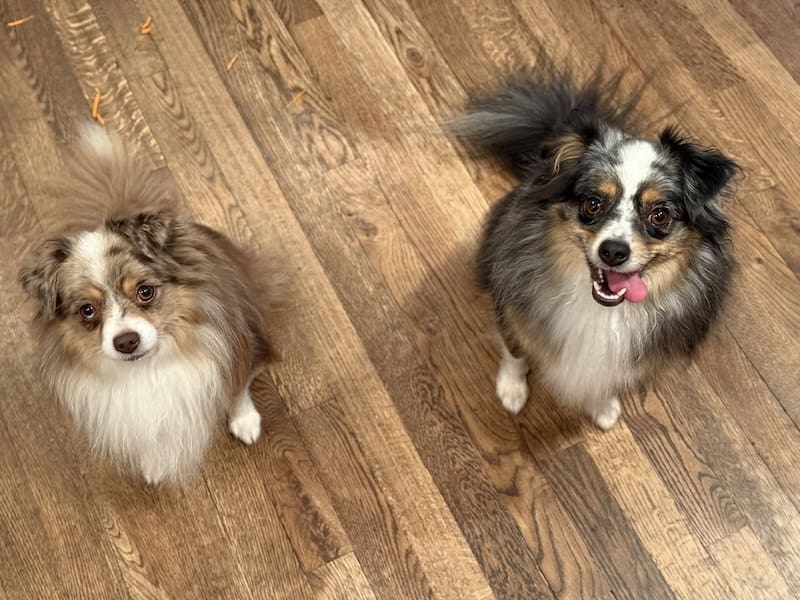
Russet, one of our breeding dogs, is a carrier for prcd-PRA. He is also a CHIC-certified, OFA Excellent-hipped, titled dog with no health issues. His carrier status doesn’t affect his quality as a dog. It just means we pay attention to who he’s bred with.
The math, briefly
Each puppy inherits one copy of each gene from each parent. For autosomal recessive conditions, a puppy must have two copies of the mutation to be affected. So:
- Carrier × Clear = zero affected puppies, ever. About half the puppies may be carriers themselves, but none will develop the disease.
- Carrier × Carrier = on average, 25% of puppies affected. This is the pairing that responsible breeders do not make.
When you pair a carrier with a clear dog, you are not taking a health risk. Some puppies will be carriers, and this only matters if those puppies go on to be bred. The puppies remain healthy.
Why “all clear” can be a red flag
Here is what the boast leaves out. A breeder who refuses to breed any carrier either misunderstands the genetics or markets to buyers who do. Either way, it tells you something.
A thoughtful breeder uses carriers strategically. They pair a carrier with a clear partner, which guarantees no affected puppies, and keep the carrier’s other qualities (temperament, structure, working ability, longevity) where they belong. Eliminating healthy carriers from a breeding program is not safer for puppies or better for the breed. It just looks tidier on a website.
Not every result on the panel works the same way
Everything above applies to autosomal recessive conditions, where two copies are required to produce disease. Most of what a DNA panel screens for falls into that category, but not all of it, and the label “carrier” doesn’t mean the same thing across the board.
MDR1 is the clearest example. Zola ”carries” one copy. That doesn’t make her sick, and it never will. What it does is change how she should be medicated: dogs with an MDR1 variant can react badly to certain common drugs, including some dewormers and anesthetics. A vet who knows before surgery handles it easily. A vet who doesn’t may not.
So one copy of MDR1 isn’t a health problem. It’s information you hand your vet, the same way you’d mention a drug allergy. Compare that to prcd-PRA, where Russet’s single copy affects nothing about his life and matters only when we decide who to breed him to.
Two different results, two different reasons they matter (and when they don’t). That’s the part the “all clear” boast flattens: it treats a panel as a scoreboard when it’s closer to a chart. What you want from a breeder isn’t a page of clears. It’s someone who can tell you which results affect your puppy’s care, which affect breeding decisions, and why.
What to actually ask
Forget “are your dogs clear.” A better question:
“What are the carrier statuses of both parents, and how do you decide which dogs to pair?”
A breeder who can answer that question concretely, who can explain why they paired a specific carrier with a specific clear dog, is a breeder who understands what they’re doing. A breeder who only says “all clear” might be giving you that answer because they understand the genetics and chose differently. Or they might be giving you that answer because it sells puppies.
You can usually tell the difference within a minute of asking the follow-up.
Our full test results for Russet, Peach, and all of our breeding dogs are linked to the original sources on our health testing page. Including the ones where Russet is a carrier.