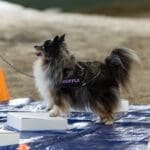
Part of the fun of breeding Toy Australian Shepherds is that you never quite know for sure what colors you’ll get in a litter. Australian Shepherd colors come in a real rainbow, every dog marked a little differently, and there’s nothing like helping a litter arrive and seeing the new color and pattern on each new puppy.
Underneath all that variety, though, the genetics are pretty orderly. Aussies come in four main colors: blue merle, red merle, black tricolor, and red tricolor, all built from two base colors and a handful of genes. Toy, mini, and standard Australian Shepherds all pull from the same color palette. The size changes; the coat genetics don’t. So everything here applies to the breed whatever its size, and if you’re weighing the sizes themselves, that’s a separate question. Here’s how it works, why no two dogs look quite alike, and the one pairing a careful breeder never makes.
What colors do Australian Shepherds come in?
Four standard colors, each built from a black or red base, plus the markings and patterning that make every dog look a little different.
Blue merle
Blue merle is the coat pattern most people picture when they think of an Aussie: a marbled mix of grey and black, sometimes with a blueish cast, broken up by patches of solid black and white. The “blue” is really diluted black; the merle gene deletes pigment from parts of a black coat, lightening it to silver or even white, and leaves the rest dark. That contrast is what gives merles their mottled look. Many blue merles also have copper points and white trim, and blue or marbled eyes are common.


Red merle
Red merle works the same way, but on a red base (also known as liver or brown) instead of black. Instead of grey and charcoal, there are patches of cinnamon, tan, and cream. Like blue merles, they often have copper points, white markings, and light or blue eyes.


Black tricolor
A black tri is solid black with white trim and copper points. Without the genetic mutation that causes the merle pattern, the black stays deep and even. The copper trim usually shows up on the face, chest, and legs, and can range in tone from a light tan to a deep brown. Interestingly, tan points are often muted at birth, and become more prominent and intense as the puppy grows.


Red tricolor
A red tri is like a black tri, but on a red base: a solid red coat with white trim and copper points. The hue of the red can range from a light cinnamon to a deep liver, with no merle, so the color comes in even rather than mottled.



Tri, bi, and solid: what the markings mean
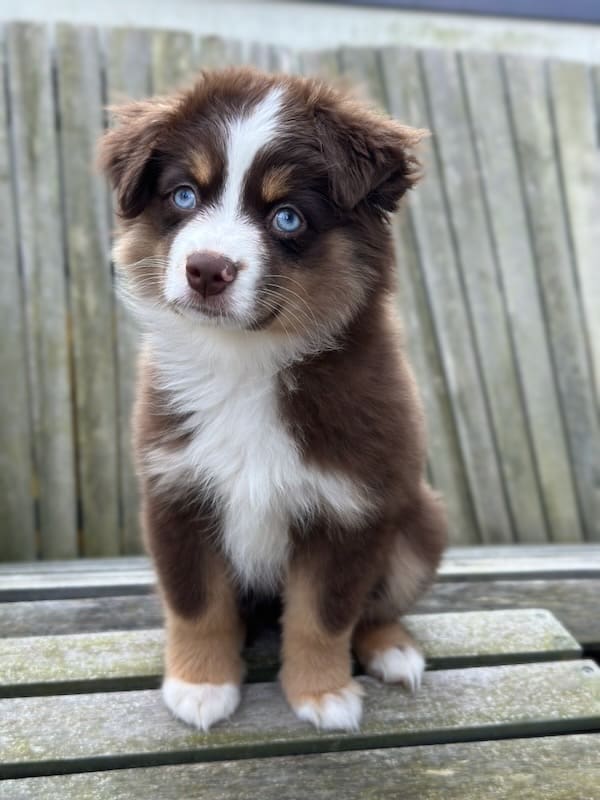
The color names describe the base coat, but Aussies are also described by their markings. A tricolor has all three elements: the base color, white trim, and copper/tan points. A bicolor has two, usually the base plus white. A solid (or “self”) dog is just the base color with no white and no copper; you don’t see this often. So a black tri and a black bi are the same black dog wearing different amounts of trim, and a blue merle with copper and white is, strictly speaking, a blue merle tricolor.
One more marking worth knowing is ticking: small flecks of the base color scattered through the white or copper areas, usually on the legs and muzzle. It often isn’t there at birth and fills in as the puppy grows, which is part of the fun of watching them develop.
What merle actually is
Merle isn’t a color; it’s a pattern caused by a single genetic mutation. A dog only needs one copy of this allele to show merle. On a black coat it produces blue merle; on a red coat, red merle.
The merle pattern can express in a number of different ways. Without going too deep into the science of merle, the patterning is caused by an insertion of DNA into the gene (known as a SINE insertion), and the length (in base pairs) of this insertion can vary. This length (known as the poly(A) tail) regulates the intensity of the merling. At very short lengths, merling can be effectively nonexistent; this is known as cryptic merle. At longer lengths, on the other hand, the merle pattern will be much more dramatic, and this is often called harlequin merle. The only way to know the length of an Aussie’s merle gene is through DNA testing.
DNA testing matters especially because of what happens if a puppy inherits two copies of the merle gene. This is known as “double merle,” and often results in excessive amounts of white that lead to ocular and auditory defects, including blindness and deafness. This is, of course, completely avoidable. A responsible breeder never breeds two merle dogs together, which is why you’ll see merle bred to tri or tri bred to tri, but never merle bred to merle from someone doing it right. A breeder producing litters of mostly-white Aussie puppies isn’t offering a rare color, they’re showing you a red flag. You can read more about how we approach genetics on our health and testing page.
How black and red are passed down
Every Aussie has one of two base colors: black or red, where “red” is really a liver brown rather than a true red. Black is dominant and red is recessive, which leads to one of the fun “surprises” in breeding. A black tri or blue merle can quietly carry red without showing it, which breeders refer to as being “red factored,” and two red-factored parents can produce red puppies even though neither parent expresses red. It’s why a black tri and blue merle pairing could still turn up a red tri or red merle in the litter, one of the many little thrills you get in the whelping box. A DNA test tells us whether a black dog carries red (or, if they have a red parent, you already know they do), so we have a good idea of what a pairing can produce, though the litter always keeps a little mystery for whelping day.
What eye colors do Aussies have?
Aussie eyes are their own kind of unpredictable in the best possible way. They may be amber, brown, green, or blue, and blue eyes can come to be in two completely different ways. In a merle, the same gene that lightens the coat can also lighten the eyes, which is why blue and partly-blue eyes are fairly common in blue and red merles. But a tri or solid Aussie with no merle at all can also have blue eyes, and that traces to a separate variant of a gene called ALX4.
Eyes can also be marbled, swirled with more than one color in the same iris, or a dog can have two different-colored eyes entirely (heterochromia), like one blue and one amber. None of it affects vision; it’s just one more thing that makes Aussies so distinctive.
White markings and excessive white
Some white is standard and expected: a blaze, a collar, white on the legs and chest. The breed standard draws a line, though, and the reason is health, not looks. White that climbs up over the ears and around the eyes can bring problems, and it doesn’t only come from double-merle breedings. Ordinary white-spotting genetics can produce a “whitehead,” a dog with a largely white head, and when white covers the ears it carries the same risk of deafness you see in double merles, for the same underlying reason: pigment cells the inner ear needs simply aren’t there. This is why a careful breeder watches the amount and placement of white, not just the coat color.
Are “rare” colors real?
You’ll see breeders advertise “rare” or “exotic” Aussie colors at a premium. Be skeptical. The four standard colors cover what a healthy, well-bred Australian Shepherd looks like. Some “rare” labels point to genuinely nonstandard colors that fall outside the breed standard: yellow dogs, where a recessive gene hides the normal black or red and leaves a clear tan-to-cream coat, and dilute dogs, where a different recessive gene fades black to a soft grey or red to a pale “lilac.” These exist, but the standard treats them as faults, not prizes, and charging more for them gets the value backwards. Other “rare” labels are just ordinary mismarks, or the excessive white of a double-merle breeding being sold as a feature. Color should be the last thing you choose a puppy on. Health, temperament, and how the puppy was raised matter far more than the pattern on its coat.
What we breed
We breed blue merle, red merle, black tri, and red tri. What any given litter brings is partly up to us and partly up to genetics, and even after the planning and the health testing are done, that last part stays a surprise right up until the puppies arrive. Truthfully, it’s one of our favorite parts of the whole process. We match puppies to homes on temperament and fit first, so if you have a color in mind, tell us, but know that the right puppy matters more than the right coat. If you’re still sorting out how toy, mini, and Miniature American Shepherds differ, that’s covered here. You can see what’s planned or available on our puppies page.
Common questions
Do merle Australian Shepherds have more health problems? A single-merle dog is as healthy as any other Aussie. The risk is specific to double merles, the result of breeding two merle parents together, which we never do.
What is a cryptic merle? A dog that carries the merle gene but barely shows it, so it can look solid or tri. Because it’s easy to miss by eye, DNA testing is the only reliable way to catch it before breeding. Depending on the length of the merle allele, a cryptic merle may be safe to breed to another merle dog without risk of producing puppies with health defects.
What does “red factored” mean? It’s a black or blue merle dog that carries one hidden copy of the red gene. The dog looks black but can produce red puppies if bred to another red or red-factored dog.
Will my puppy’s color change as it grows? Often, yes, especially red merles. Coats lighten, deepen, and shift through the first year, so the adult dog can look noticeably different from the puppy. Patches of white can also shrink over time, as a puppy develops more pigmentation, and ticking can develop.
Do all Australian Shepherds have blue eyes? No. Blue eyes are relatively common in merles and show up in some tris through the ALX4 variant, but plenty of Aussies have amber, brown, or green eyes, and some have one of each.