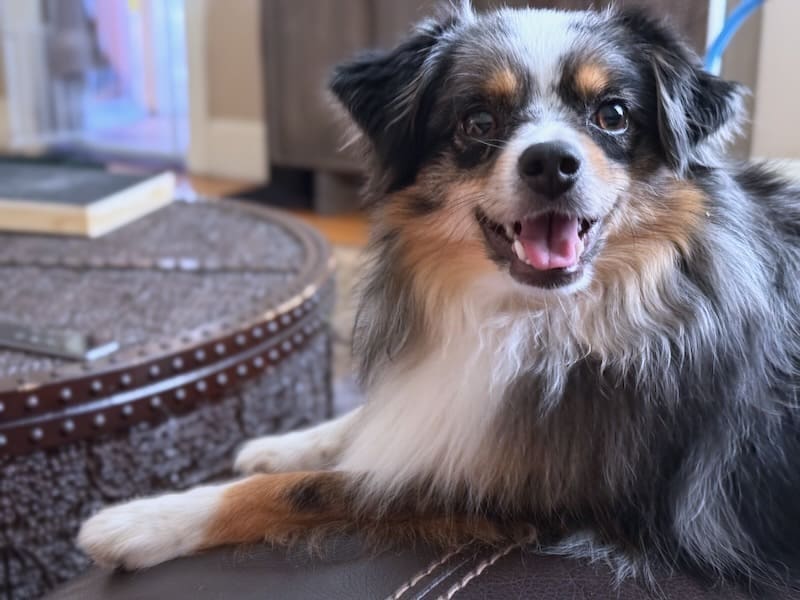
For a Toy Aussie, apartment life can be just fine, but with some BIG caveats.
A Toy Australian Shepherd is small. They physically fit in an apartment just fine. What doesn’t fit quite as neatly is the great big working-dog brain inside that tiny head, and whether your lifestyle can accommodate it. That’s the real question, and the answer depends entirely on you, not on your square footage.
Size is the least important variable
Most people ask this question because they’re thinking about space. Will the dog have enough room to move around? Will a small apartment feel cramped?
Those are fair questions, but they don’t determine if an apartment is a good fit. I’ve seen Toy Aussies thrive in 600-square-foot apartments and bounce off the walls in houses with big yards. The yard doesn’t exercise the dog; the owner does.
What a Toy Aussie needs isn’t space but movement and mental work. A daily 20-minute walk doesn’t cut it. But an owner who runs, hikes, trains frequently, or brings the dog along on adventures most days? That dog will be fine in a studio.
Toy Aussie apartment life: what the commitment actually looks like
Here’s an honest picture of what an adult Toy Aussie’s day needs to look like in an apartment:
| Morning | 30-minute active walk or run — not just a potty break |
| Midday | 10–15 minutes of training or a puzzle feeder |
| Evening | Second exercise session: fetch, dog park, sniff walk, or training |
| Before bed | Short decompression walk |
Physical exercise alone isn’t enough for a dog this smart. Ten minutes working on new commands or running through known ones does more for the mind of your furry roommate than an extra lap around the block. We start our puppies with training and enrichment opportunities, so they arrive at their new homes comfortable with structured activity and engagement.
If your schedule means the dog is alone for 8 or 9 hours without a break, this is not the breed for you. Australian Shepherds were bred to work alongside their humans all day, every day, and they won’t be content loafing on the couch and waiting for you to come home.
What goes wrong
The failures I’ve seen usually come down to one of two things: not enough enrichment or not enough consistency.
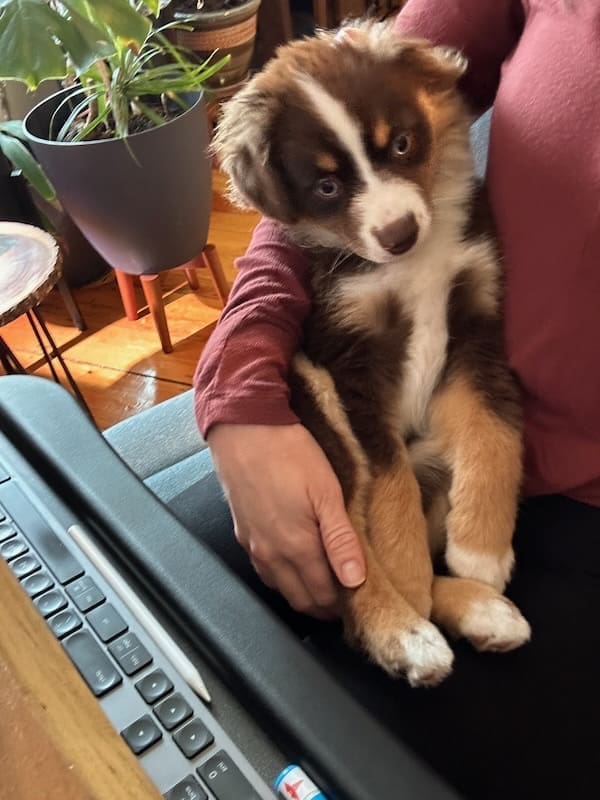
Under-enriched Toy Australian Shepherds get creative. They become amateur interior decorators. They bark. They invent games involving your furniture. It’s not spite, but a dog with nowhere to put its mental and physical energy. The good news is it’s predictable and preventable.
Another challenge is the herding instinct. In a house with a yard, a dog that wants to circle and herd has more room to express that without affecting others. In an apartment, it’s more concentrated. Cats, kids, or even your ankles can become targets if the behavior isn’t redirected early. It’s manageable with training, but worth knowing.
The apartment dweller who does great
I genuinely love placing puppies with apartment dwellers when the fit is right. The owners who do best tend to share a few things:
- They’re active. They run, hike, or get to a park regularly — and they see the dog as a reason to do those things, not an obstacle.
- They’re home enough. Remote workers and people with flexible schedules tend to do well. Not because the dog can’t be alone, but because more touchpoints throughout the day mean more training opportunities and less boredom.
- They’re eager to train. A Toy Aussie in an apartment that gets to exercise its brain has better impulse control and is an easier dog to live with. This goes for homes of any size, but problems hit harder in a smaller space.
- They’ve thought about it. The fact that you’re reading this is a good sign. Often, people who struggle chose a Toy Aussie for its looks or its size, not because it was a good fit for their lifestyle.
The apartment dweller who struggles
A Toy Aussie is probably not the right fit if your day runs 10+ hours outside the home with no plan for midday exercise, if your exercise plan is “they’ll run around in here,” or if you expect a low-maintenance dog that settles naturally into a calm routine. Some breeds do that. Toy Aussies aren’t one of them, especially in the first couple of years.

Frequently asked questions
Do Toy Aussies bark a lot in apartments?
They might! Aussies are often quite vocal. Boredom and under-stimulation will make barking much worse, though. A well-exercised, mentally engaged Toy Aussie is a quiet(er) one, but I would never describe my dogs as “quiet.”
Can I leave a Toy Aussie alone in an apartment while I work?
I would think long and hard about whether a Toy Aussie is the right dog for you if it’s going to be home alone five days a week. Adult Toy Aussies can handle a normal workday with a midday walk or dog walker, but it’s really not ideal. Puppies under six months need more frequent breaks — plan for someone to come in at least twice midday.
Do Toy Aussies do okay in cities?
Generally, yes, if they’re well-socialized. We start that work in the whelping box, exposing puppies to different sounds, surfaces, and experiences before they go home. A puppy with a solid foundation of positive, novel experiences adjusts to city life more easily than one encountering it cold.
What’s the hardest part of apartment life with a Toy Aussie?
The puppy and adolescent phases! Toy Aussies are extra demanding in their first two years. They’re fast, curious, and have a lot of energy with very little impulse control. It gets easier, but it’s worth being prepared for that stretch rather than surprised by it.
If you’re an apartment dweller who’s already thinking this carefully about the fit, that’s exactly the kind of owner a Toy Aussie does well with. Here’s how our process works.